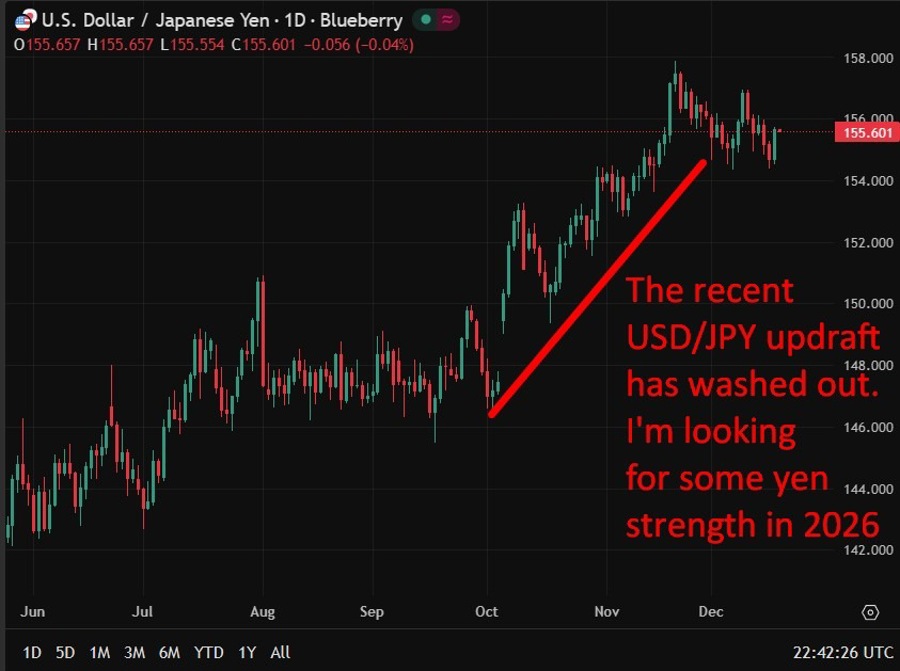
The Bank of Japan is widely expected to deliver a 25bp rate hike at the conclusion of its policy meeting on Friday, December 19, a move that is now almost fully priced by markets. With the outcome largely anticipated, investor attention will shift squarely to Governor Kazuo Ueda’s press conference, scheduled for 06:30 GMT (0130 US Eastern time) for guidance on the pace and limits of further policy normalisation.
Despite the near-certainty of a hike, expectations are low that Ueda will strike a hawkish tone. Policymakers remain acutely aware of the sharp rise in Japanese government bond yields and the sensitivity of domestic financial conditions to higher rates. Even after the expected increase, the BoJ assesses real interest rates as remaining firmly negative, reinforcing the view that policy will stay accommodative in real terms and that tightening will proceed cautiously.
Market pricing currently points to another rate hike as early as June or July next year. However, some analysts argue this timeline is too aggressive. A growing view is that October 2026 represents a more realistic window, allowing the BoJ time to assess how higher borrowing costs filter through to corporate financing, bank lending, household consumption and capital expenditure. Spring wage negotiations and the yen’s exchange rate will be particularly important inputs into that assessment.
The debate around Japan’s neutral rate has also resurfaced. While recent remarks from Governor Ueda about reassessing neutral policy settings triggered outsized market reactions, policymakers continue to stress that the neutral rate is a conceptual range rather than a precise target. The BoJ is expected to maintain its current estimate of 1–2.5% for the foreseeable future, suggesting no urgency to accelerate tightening beyond gradual steps.
From a market perspective, the fully priced nature of this week’s hike reduces the risk of volatility. Unlike the August 2024 move, which triggered sharp yen-funded carry unwinds and ripples across emerging market currencies, this decision is unlikely to generate such dramatic spillovers. With little surprise factor, the yen’s reaction should depend more on forward guidance than the hike itself.
Looking further ahead, some strategists have turned more hawkish than consensus, now pencilling in an additional 25bp hike in Q3 2026. With markets leaning toward a later move, this divergence implies potential upside risks for the yen in the second half of 2026 as BoJ and Federal Reserve policy paths increasingly diverge.