After holding rates last week and stressing caution at his press conference, Bailey’s Sunday AlUla speech reinforced a data-dependent stance, with AI a long-run theme but inflation confidence still the near-term hurdle.
Earlier re GBP:
Summary:
Last week: the Bank of England held rates, underscoring a cautious, data-dependent stance
Last week (press conference): Governor Andrew Bailey leaned on disinflation progress, but stressed the need for more evidence before easing further
Sunday: Bailey spoke at the IMF/Saudi Ministry of Finance AlUla conference, broadening the focus to global themes, with AI a major pillar
Despite the AI-heavy framing, he still pointed to soft growth realities and lingering inflation risks that keep policy cautious
For markets, the sequencing reads as: no rush to cut, watch inflation persistence and labour-market cooling, with GBP and gilts sensitive to incoming data
The Bank of England’s policy message over the past week has landed in a clear sequence for markets: a hold decision last week, followed by Governor Andrew Bailey’s press conference, and then Bailey’s AlUla speech on Sunday at the IMF/Saudi Ministry of Finance conference.
At last week’s decision, the Bank signalled it remains in wait-and-watch mode, balancing progress on inflation against an economy that still looks fragile. In the press conference that followed, Bailey reinforced the idea that disinflation is moving in the right direction, but he emphasised that the MPC needs greater confidence that inflation will stay sustainably at target before shifting to an easier stance.
That context mattered for Bailey’s appearance on Sunday in AlUla. While his speech leaned heavily into AI and technology, particularly how productivity gains may reshape economies, it also sat firmly downstream of the Bank’s near-term policy debate. The key takeaway for macro traders was not that the BoE has pivoted, but that Bailey is framing the UK policy challenge within a broader global story: structurally weak productivity, uncertain growth, and persistent shocks that can revive inflation pressures even as headline rates cool.
Bailey used the AlUla setting to emphasise the scale of change AI could bring, but also the uncertainty around timing and transmission, a point that dovetails with the BoE’s reluctance to pre-commit on rates. Productivity improvements may ultimately help ease inflation constraints, but they are not a near-term policy lever. In the meantime, the MPC still has to navigate the here-and-now: how quickly inflation falls, how decisively labour-market tightness eases, and whether growth remains soft enough to justify eventual cuts without reigniting price pressures.
Analysts think the combined message across the three events is consistent: the BoE is not closing the door on rate cuts, but it is not ready to declare victory either. The market’s focus now shifts to the next round of inflation prints, wage signals, and demand indicators to test whether last week’s caution gives way to a clearer easing path later in 2026, or whether policymakers stay restrictive for longer.
---
GBP: still headline- and data-sensitive; policy caution supports two-way volatility rather than a clean trend
Gilts: front-end anchored by “no rush” guidance; long-end sensitive to growth/inflation balance and global risk premia
UK equities: domestic cyclicals benefit if cuts come into view, but the timing remains uncertain
---
The big story so far today is the Japanese election, yen update:
- Yen weaker early trade. Japan markets brace for renewed Takaichi trade after landslide win
- Weak yen update: Japan election landslide Takaichi super-majority, revives yen pressure
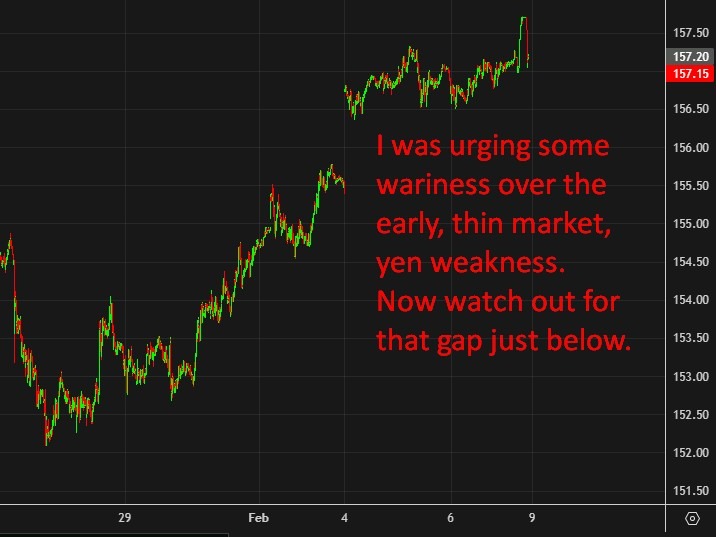
We've filled the very early Asia gap, now watch out for a bigger picture sell off addressing the gap shown from last week. It'd require a much more extensive USD/JPY sell off.